What's Actually on the Truck
Every delivery truck carries fuel in DOT-compliant tanks built specifically for transporting gasoline and diesel on public roads, with separate compartments so gas and diesel never mix. Fuel is dispensed through a metered nozzle — the same style of pump you'd see at a station, just mounted on the truck — so the number on the receipt is the exact number of gallons that went into your tank, not an estimate.
The Process, Start to Finish
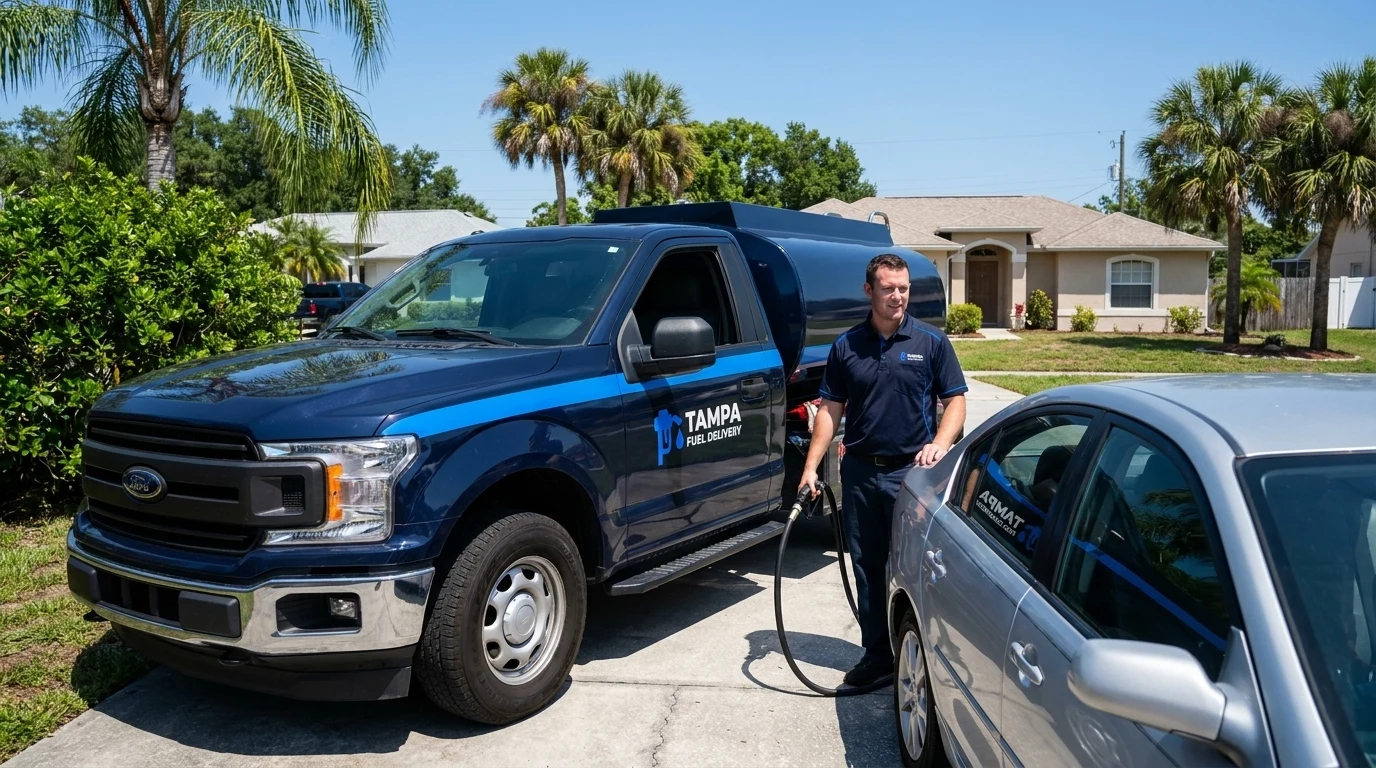
A call starts with dispatch getting your location and vehicle, then confirming what you need and quoting a firm price. Once a truck is en route, you get a real ETA — most Tampa-area calls run 30 to 60 minutes. When the driver arrives, they position the truck safely, ground the equipment, run the nozzle to your fuel door, and pump exactly the amount agreed on. You pay by card or Apple Pay on-site and get an emailed receipt before the truck leaves. The whole on-site process for a single vehicle usually takes 15 to 25 minutes.
Why It's Not the Same as Siphoning Gas From a Can
A lot of the hesitation around mobile delivery comes from picturing something informal — a guy with a gas can and a funnel. That's not what a licensed delivery service looks like. There's no open pouring, no spillage risk from a hand-carried container, and no guessing how much a can actually held. The metered nozzle and sealed hose connection mean the fuel goes straight from the truck's tank into yours, the same way it would at a pump, just without you standing at one.
Handling Locations That Aren't a Driveway
Delivery works in more places than people expect — a highway shoulder, a parking garage, a storage yard, even a rural property at the end of a long driveway. In an area like Lutz, where a lot of properties sit on acreage with long driveways well off the main road, drivers are used to working with gate codes and specific entry instructions given ahead of time, the same way they'd confirm access to any storage lot or gated community.
What to Ask If You Want to Verify Before You Call
A legitimate operator will be able to tell you, without hesitation, that they're licensed and insured, that pricing is quoted on the phone before the truck rolls, and that you'll get a receipt showing the metered gallon count. If any of those answers feel evasive, that's worth paying attention to — but for an established, licensed mobile fuel delivery operation, none of it should be a hard question to answer.
The Bottom Line
Mobile fuel delivery isn't a workaround or a gray-area service — it's a regulated way to get gas or diesel to a vehicle that can't easily get to a station, using the same metered, DOT-compliant equipment a station itself would use. The only real difference is that the pump comes to you.
Why Most Customers Only Have One First-Time Question
In practice, the safety question almost always comes up on the first call and rarely again after that. Once someone's watched a driver ground the equipment, run a metered fill, and hand over a receipt with the exact gallon count, the process stops feeling unusual — it starts feeling like exactly what it is: a normal fuel transaction that happens to take place in a driveway or on a shoulder instead of at a pump island.
Licensed and Insured Isn't Just a Line on a Website
Operating a fuel delivery service in Florida means carrying real commercial insurance and following state and federal rules for transporting and dispensing gasoline and diesel — the same regulatory framework that governs how fuel moves from a terminal to a station in the first place. That's what separates a legitimate delivery operation from an informal setup, and it's the reason a real operator never hesitates when you ask about it directly.
 HOW IT WORKS