Why "Testing It" Is a Bad Idea
There's a real mechanical reason not to treat the reserve as a game. In most modern cars, the fuel pump sits inside the tank and uses the fuel itself as a coolant and lubricant. Run the tank low too often, and the pump starts sucking air along with fuel, running hotter than it's designed to and wearing down faster. Over time that habit can shorten the life of a part that's expensive and inconvenient to replace — a cost nobody thinks about until the pump actually fails. There's also sediment: fuel tanks collect small amounts of debris over the years, and it settles at the bottom, right where the pump intake sits. A full tank keeps that debris covered and mostly out of the way; a chronically near-empty tank stirs it up more often.
The Fuel Gauge Isn't as Precise as It Feels
Fuel gauges are calibrated to be conservative, but they're not exact — hills, hard acceleration, and even how level the car is parked can all shift the reading. That's part of why "I still had a quarter tank" is one of the most common things drivers say right before they stall. Treat the gauge as a rough guide, not a countdown timer, and treat the low-fuel light as a hard deadline, not a suggestion.
Where This Matters Most in Tampa Bay
Running the tank down close to empty is a minor inconvenience on city streets with a station every mile. It's a real problem on longer stretches with fewer options — the drive out I-4 through Plant City toward Lakeland, for instance, has real gaps between exits with easy fuel access, and it's a corridor where personal vehicles and RVs crossing between Tampa and Lakeland regularly misjudge how much reserve they actually have left. The same logic applies heading north on I-75 toward Wesley Chapel or out toward the Suncoast Parkway — the farther you get from the dense cluster of stations near downtown, the more that "I'll fill up later" habit can catch up with you.
What to Do If You're Already Close to Empty
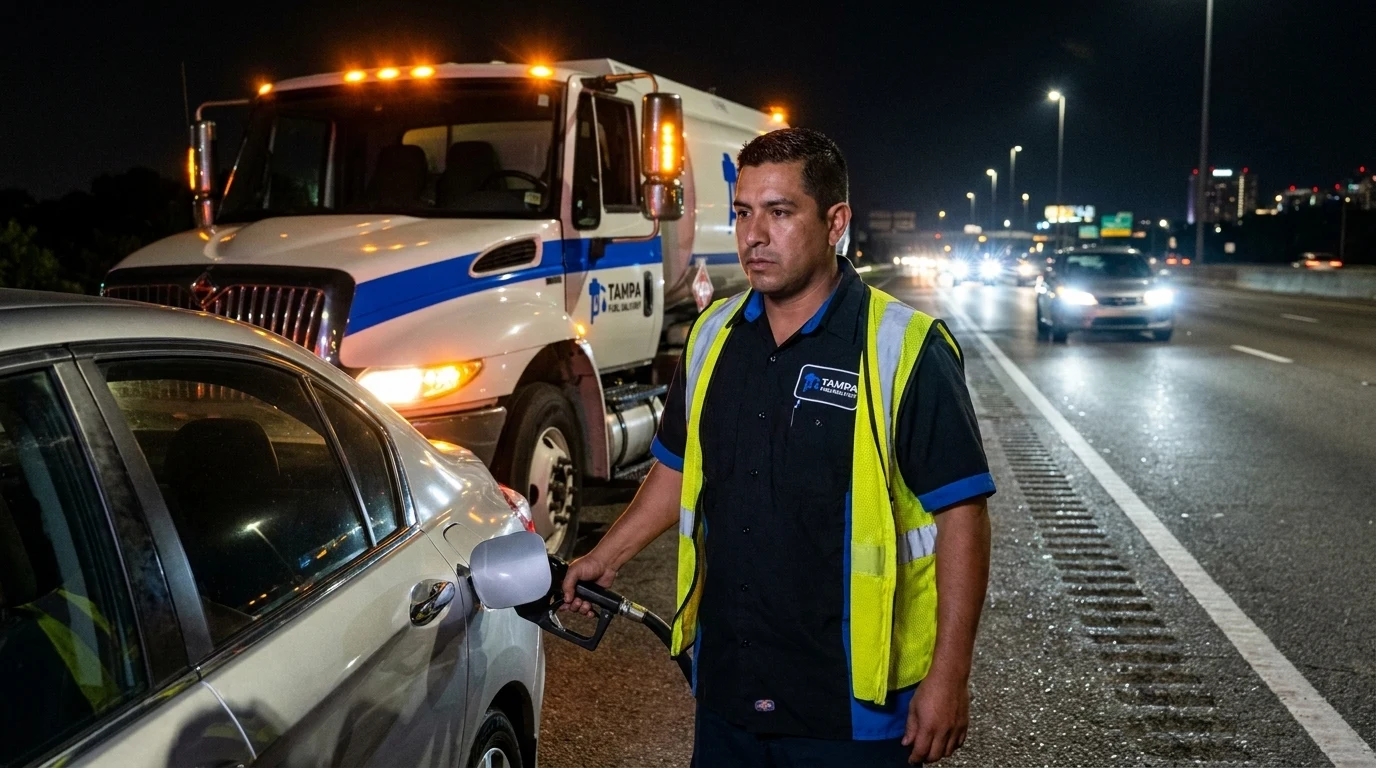
If the light's on and you're not sure you'll make it, don't keep pushing to see how far the needle goes — pull off at the next safe opportunity and either find the nearest station or call for delivery. Roadside fuel delivery exists precisely for the moment the math doesn't work out: a truck brings gas straight to wherever you've stopped, so you're not gambling on whether the reserve holds for one more exit.
A Better Habit Than Pushing the Limit
The simplest fix costs nothing: treat a quarter tank as the real "low," not empty. Fill up before a long trip rather than planning to stop somewhere along the way, and keep an eye on the gauge on any drive that takes you outside your normal daily loop. It's a lot cheaper than a tow, a lot less stressful than the shoulder of I-75, and a lot easier on a fuel pump that's expensive to replace.
Traffic and AC Change the Math More Than People Expect
Two identical cars with identical reserve fuel can get very different results depending on how they're driven in those last few miles. Stop-and-go traffic burns noticeably more fuel per mile than a steady highway cruise, and running the air conditioning hard in Tampa's summer heat adds its own draw on the engine. A near-empty tank that might have coasted 40 miles on the open road on a mild day can come up short at 25 miles if it's 95 degrees out and you're crawling through construction on Dale Mabry.
What Other Drivers Get Wrong
The most common mistake isn't ignoring the light entirely — it's underestimating how quickly "I'll get gas after this errand" turns into three more stops. A dashboard warning that reads 40 miles of range at 9 AM doesn't account for the extra ten-minute detour, the school pickup line, or the unplanned stop at the store. Treat the estimated range on the dash the same way you'd treat the fuel gauge itself: as a rough number that shrinks faster than expected once the day gets busy.
 FUEL GAUGE · MYTHS